.png)
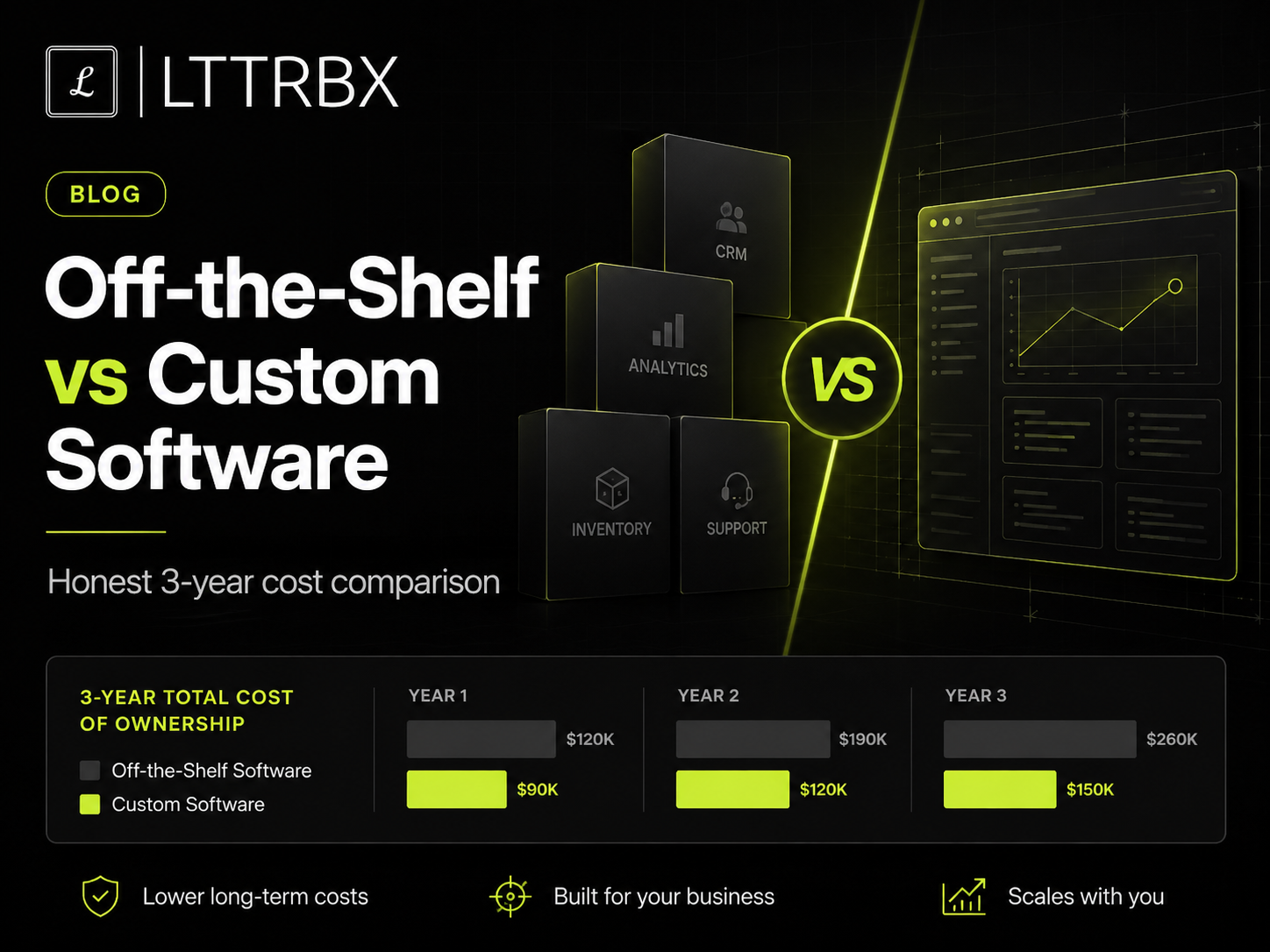
The short answer. In 2026, custom software in India typically costs ₹3,00,000–₹8,00,000 for a focused MVP, ₹8,00,000–₹25,00,000 for a mid-complexity product with multiple modules and integrations, and ₹25,00,000–₹1,00,00,000+ for enterprise-grade systems. The price is driven by features, integrations, number of platforms, and the experience of the team — and the cheapest quote is very often the most expensive in the end.
It's the question every founder asks and few agencies answer straight: what does it actually cost to build custom software in India? The honest answer is a range, because a simple internal tool and a multi-platform enterprise system are worlds apart. But “it depends” helps no one, so here are real 2026 ranges by complexity, what moves them, and how to read a quote without getting burned.
First, what you're paying for
Custom software cost is mostly people's time: discovery and planning, UI/UX design, front-end and back-end development, testing, deployment, and post-launch support. You're not buying a product off a shelf — you're funding a team to design, build and prove something that fits your business exactly. That's why scope, not “hours,” is what really determines the number.
The three complexity tiers, with ranges
MVP / focused tool: ₹3,00,000–₹8,00,000. A single-purpose app or the first version of a product — core features, one or two platforms, minimal integrations. The goal is to launch, learn and validate. Right for startups and for testing an idea before investing heavily.
Mid-complexity product: ₹8,00,000–₹25,00,000. Multiple modules, user roles, a few third-party integrations (payments, messaging, maps), an admin panel, and both web and mobile. This is where most serious business systems land — a real product used daily by real users.
Enterprise-grade system: ₹25,00,000–₹1,00,00,000+. Many modules, complex workflows, heavy integrations, high security and compliance needs, scale for large user bases, and ongoing evolution. Right for established businesses digitising core operations.
What drives the cost up or down
- Number of features and screens. Every feature is design, build, test and maintenance. Scope is the biggest lever — and where discipline saves the most money.
- Integrations. Connecting to payment gateways, messaging, accounting or third-party APIs adds real work, especially when those systems are finicky.
- Platforms. Web only is cheaper than web plus iOS plus Android. Cross-platform frameworks help, but more surfaces still means more cost.
- Team experience. A senior team costs more per hour but usually less overall — fewer mistakes, less rework, and a product that survives contact with real users.
Fixed price vs time-and-materials
Fixed price works when scope is clear and stable — you know the number upfront, but changes cost extra. Time-and-materials works when you expect to evolve the product — you pay for effort as you go, with flexibility to adapt. For a well-defined MVP, fixed price is often cleaner; for an evolving product, T&M usually serves you better. A good partner will recommend the model that fits your project, not the one that suits them.
Why the cheapest quote is usually the most expensive
A quote far below the others is a warning, not a bargain. It usually means one of three things: the scope wasn't understood (so change orders will balloon the real cost), the work will be junior and need redoing, or corners will be cut on testing and architecture and you'll pay in bugs and rebuilds. The most expensive software isn't the one with the highest quote — it's the cheap one you have to build twice.
The bottom line
Budget by complexity, scope ruthlessly, choose a team by track record rather than price alone, and treat a suspiciously low quote as the red flag it is. At LTTRBX we scope openly and give itemised estimates, so you know exactly what you're paying for — and we'll tell you when a smaller build or an off-the-shelf tool would serve you better than a big custom project.
Frequently asked questions
How much does it cost to build an app in India in 2026?
A focused MVP typically runs ₹3–8 lakh, a mid-complexity product ₹8–25 lakh, and an enterprise-grade system ₹25 lakh to ₹1 crore or more, depending on features, integrations and platforms.
Why do software quotes vary so much?
Because scope, team experience and quality differ hugely. A low quote often means limited scope, junior work or cut corners — costs that reappear later as change orders, bugs or a rebuild.
Should I choose fixed price or time-and-materials?
Fixed price suits a clearly defined project; time-and-materials suits a product you expect to evolve. Match the model to how stable your scope is.